> For the complete documentation index, see [llms.txt](https://docs.tibero.com/prosync/llms.txt). Markdown versions of documentation pages are available by appending `.md` to page URLs; this page is available as [Markdown](https://docs.tibero.com/prosync/administration/apply/apply-process.md).
# Apply Process
Apply 프로세스에 대하여 설명한다.
## Process 설명
Apply 프로세스는 [제품 설계](/prosync/introduction/architecture.md)에서도 언급했듯이 ***Chunk*** 단위로 레코드를 전달받고 해당 레코드를 트랜잭션별로 모아준다. 트랜잭션에 Commit이 오면 해당 트랜잭션은 실제 반영 단계에 들어가 대상이 되는 데이터베이스로 반영된다.
본 장에서는, 실제 apply 프로세스의 구조를 상세히 설명한다.
***
## Threads
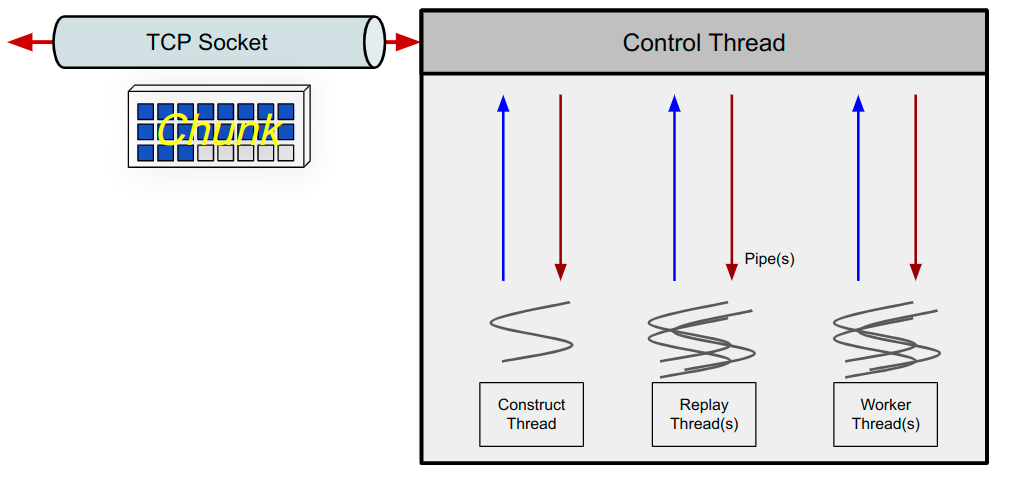
그림 1. Apply Process Architecture
Apply 프로세스는 위와 같은 구조를 가지고 있다. 앞서 [제품 설계](/prosync/introduction/architecture.md#inter-processes-threads-communication)에서 ProSync의 기본 Thread 구조를 언급한 바 있는데, Apply도 마찬가지로 Main이 되는 Control Thread가 있고 이외에 Worker Thread들이 Control Thread 하위 계층에 구성되어 있다.
동기화에 필요한 Thread는 Construct Thread와 Replay Thread로 크게 두 가지이며, 나머지는 모두 Worker Thread로 구분된다.
{% hint style="info" %}
**참고**
Worker Thread는 종류가 많은 관계로 하단에 간단히 언급한다.
{% endhint %}
### Control Thread
Control Thread는 다른 프로세스와 마찬가지로 모든 통신과 관련된 Multiplexing I/O를 담당한다. 리눅스에선 epoll을 사용하며, 플랫폼별로 k-queue나 pollset 등 각 운영체제에 알맞은 Mux I/O 기능을 사용하도록 설계되어 있다.
### Construct Thread
Construct Thread는 \_**Chunk**\_로 들어오는 레코드 데이터들에 대해 트랜잭션으로 재조립한다. Construct라는 말의 의미는 트랜잭션을 다시 조립(**Construct**)하기 때문에 사용된다고 생각하면 된다.
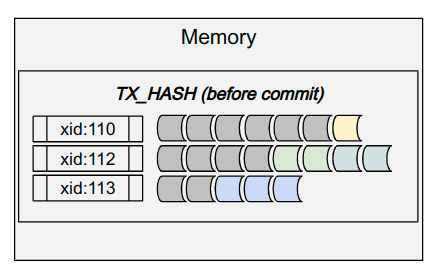
각 레코드에는 본인이 속한 트랜잭션을 구분할 수 있는 일종의 key 값이 존재하는데, 이게 트랜잭션의 ID 일명 (xid)라고 불린다.
Construct는 레코드의 xid 값을 보고 트랜잭션별로 재조립한다.
그림 2. Construct의 트랜잭션 Hash
{% hint style="info" %}
**참고**
**Construct의 이력 정보 관리**
Construct는 레코드별로 어떤 redo 로그 파일에서 나온 건지에 해당하는 로그 시퀀스 정보와 해당 로그 파일의 몇 번째 레코드에 해당하는지에 대한 정보(wrap#)를 메모리에 계속 저장하게 된다.
redo 로그는 주기적으로 로그 스위치가 일어나고, 이때마다 로그 시퀀스 값이 1개씩 올라가며 새로운 로그파일에 레코드를 작성하게 되는데, 이때마다 메모리에 들고 있던 레코드 정보 및 이력 정보(로그 시퀀스, wrap#)가 물리 디스크 및 데이터베이스에 저장된다.
{% endhint %}
### Replay Thread
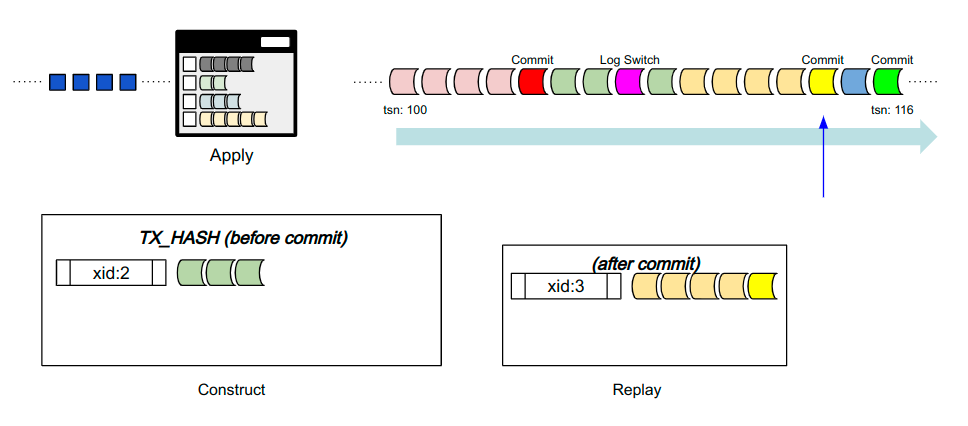
Replay Thread는 Commit 레코드가 도달하여 Construct로부터 조립이 완료된 트랜잭션을 전달받는다. 전달받은 트랜잭션은 Commit 레코드의 DB Time(Oracle의 SCN / Tibero의 TSN / ..)에 맞게 직렬화되어 반영되거나, 트랜잭션 내 레코드들의 의존성을 모두 체크하여 병렬로 처리된다.
병렬로 처리하게 될 경우 Replay Thread의 개수가 많아지게 되며, 각 스레드가 DB의 한 세션을 담당하게 된다. 병렬 처리 가능 여부는 Control Thread에서 실시간으로 판단하며, 병렬 처리가 가능할 때 여러 Replay Thread에 일감을 부여하게 된다.
그림 3. Replay로 넘어간 트랜잭션
### Worker Threads
#### Resource Thread
프로세스의 CPU / Memory 사용량을 실시간으로 수집한다. 수집된 내용은 로그상에 계속해서 남게 되며, 프로싱크 매니저와 연동 중일 경우, Agent 프로세스를 통해 수집한 값을 프로싱크 매니저로 전송한다.
#### Stat Thread
프로세스에서 발생하는 트랜잭션의 시간당 처리량, 일종의 Throughput을 계산한다. 프로싱크 매니저와 연동 중일 경우, Agent 프로세스를 통해 수집한 값을 프로싱크 매니저로 전송한다.
###
---
# Agent Instructions
This documentation is published with GitBook. GitBook is the documentation platform designed so that both humans and AI agents can read, navigate, and reason over technical content effectively. Learn more at gitbook.com.
## Querying This Documentation
If you need additional information that is not directly available in this page, you can query the documentation dynamically by asking a question.
Perform an HTTP GET request on the current page URL with the `ask` query parameter, and the optional `goal` query parameter:
```
GET https://docs.tibero.com/prosync/administration/apply/apply-process.md?ask=&goal=
```
`ask` is the immediate question: it should be specific, self-contained, and written in natural language.
`goal` is optional and describes the broader end goal you are ultimately trying to accomplish on behalf of the user. GitBook uses it to tailor the answer towards what is most useful for that goal.
The response will contain a direct answer to the question and relevant excerpts and sources from the documentation.
Use this mechanism when the answer is not explicitly present in the current page, you need clarification or additional context, or you want to retrieve related documentation sections.